
When Your Insurer Drags Its Feet: Understanding Texas Penalty Interest
Key Takeaways: When a Texas home insurance payout arrives late, state law can force insurers to pay extra, with penalties reaching 18 percent annual interest on top of what is owed. Under Tex. Ins. Code § 542.060(a), an insurer violating Chapter 542’s prompt-payment rules must pay this interest plus reasonable attorney’s fees stacked on underlying claim benefits. Interest accrues from the date of the statutory violation until judgment is rendered in the trial court, so delay grows increasingly costly. Insurers must meet firm deadlines, including 15-day acknowledgment requirements, and cannot deny claims without reasonable explanation or investigation. For weather-related claims under Chapter 542A, a simple-interest calculation may replace the flat 18 percent rate. Houston windstorm claims generally must be filed within one year of the loss. Because outcomes depend on policy language and facts, reviewing a delayed or denied claim with counsel can help protect your recovery.
If your Texas home insurance payout arrives late, state law can force your insurer to pay extra. Texas imposes a penalty on carriers that violate prompt-payment rules, reaching 18 percent annual interest on top of what you are owed. For Houston homeowners recovering from hail, wind, or hurricane losses, this rule turns an insurer’s delay into a meaningful financial consequence.
If your storm claim has stalled, the team at Fitts Law Firm, PLLC is ready to help you understand your options. Call our office at 713-871-1670 or reach us through our confidential case review form to discuss what a delayed payout may mean for you.
How the 18% Penalty Interest Rule Actually Works
The 18 percent figure comes directly from the Texas Insurance Code, not from a courtroom formula.
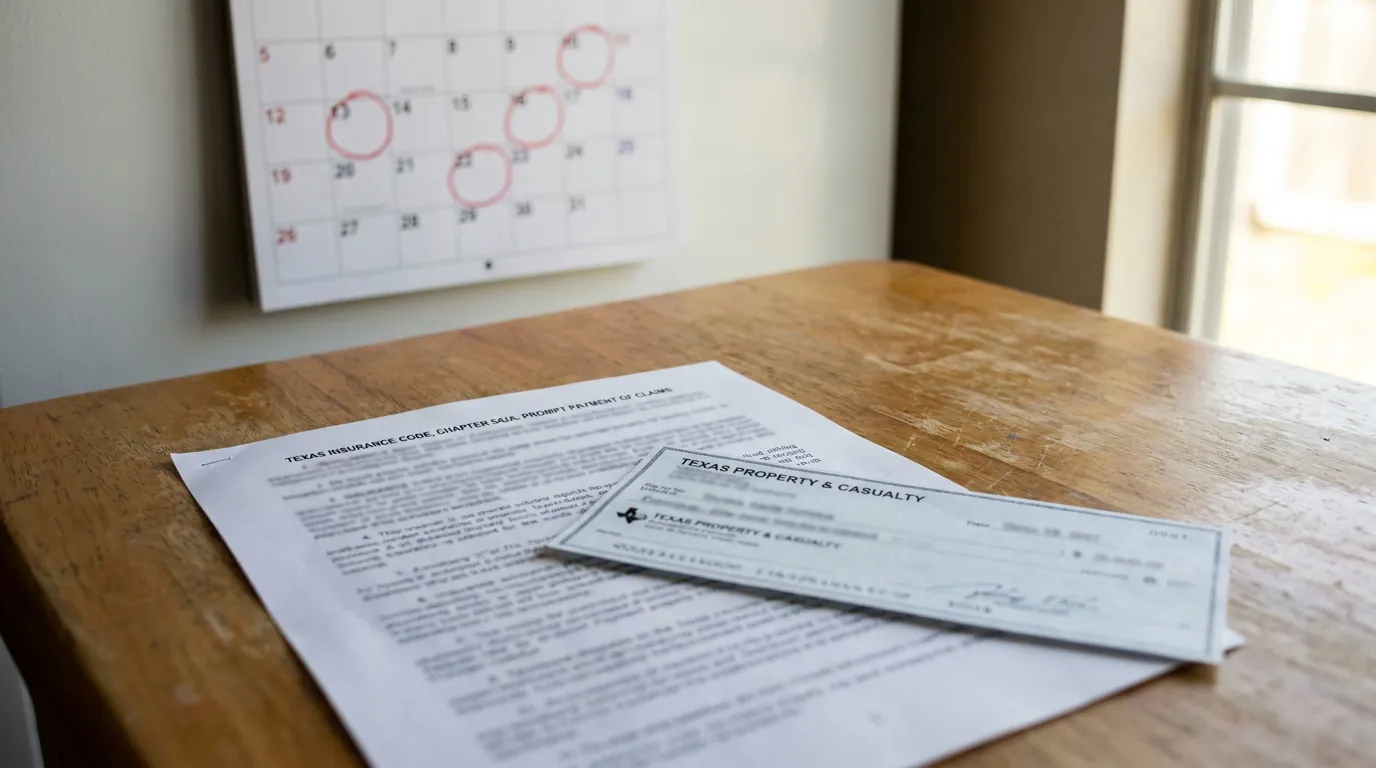
Tex. Ins. Code § 542.060(a) requires insurers not in compliance with Chapter 542’s prompt-payment subchapter to pay 18 percent annual interest as damages, plus reasonable and necessary attorney’s fees.
This penalty stacks on top of the benefits you were already entitled to receive.
The penalty is in addition to underlying claim benefits and attorney’s fees, and does not preclude recovery of ordinary prejudgment interest, giving policyholders layered remedies for delay.
The interest is not a flat, one-time charge that stops accruing.
The 18 percent interest begins running from the date of the statutory violation and continues until judgment is rendered in the trial court, so the longer the insurer stalls, the more it owes. Post-judgment interest under the Texas Finance Code may apply thereafter. The full statutory framework appears in the Texas Insurance Code on prompt payment.
💡 Pro Tip: Keep a dated log of every phone call, email, and letter from your insurer. Because penalty interest can be tied to specific deadlines, a clear timeline often becomes the backbone of a delayed-payout dispute.
Deadlines Insurers Must Meet Under the Prompt Payment Act
Texas law sets firm clocks that insurers must follow once you file a first-party claim.
Subchapter B codifies the Texas Prompt Payment of Claims Act, setting deadlines for acknowledging, investigating, and paying first-party claims whose violation triggers the 18% penalty.
One of the earliest triggers is the acknowledgment requirement.
The statute establishes strict claim-handling deadlines, including a 15-day acknowledgment requirement under Tex. Ins. Code § 542.055, that trigger the penalty when missed.
A different provision addresses what happens when payment lands very late.
Under Tex. Ins. Code § 542.058, an insurer that delays payment more than 60 days after receiving all reasonably requested proof of loss becomes liable for the claim amount plus the 18 percent penalty interest and attorney’s fees under § 542.060.
Common Delay and Denial Tactics the Law Targets
The Insurance Code does more than police missed deadlines; it also addresses how insurers communicate and investigate.
Insurers may not fail to promptly give a policyholder a reasonable explanation for a denial under Tex. Ins. Code § 541.060(a)(3), and may not refuse to pay a claim without first conducting a reasonable investigation under § 541.060(a)(7).
Texas also treats certain settlement conduct as an unfair practice.
Tex. Ins. Code § 541.060(a)(2) makes it unlawful for an insurer to fail to attempt in good faith to reach a prompt, fair, and equitable settlement once the insurer’s liability has become reasonably clear. Homeowners can review these unfair-settlement provisions in the Texas statute on settlement practices.
Common warning signs of an improperly handled claim include:
- Repeated requests for documents you already provided
- A denial letter that never explains the policy basis for the decision
- An adjuster who goes silent for weeks after a site inspection
- A settlement offer far below your independent repair estimates
💡 Pro Tip: Ask your insurer to put every coverage position in writing. A written denial that lacks a clear policy explanation may itself point to a statutory violation.
Special Rules for a Houston Storm Damage Claim
Not every property claim uses the same flat 18 percent calculation.
For weather-related property claims governed by Chapter 542A, Section 542.060(c) substitutes a simple-interest calculation, set at 5 percent plus the rate determined under Section 304.003 of the Finance Code (which is the prime rate, floored at 5% and capped at 15%), rather than the flat 18% rate. The statute does not contain an explicit 20 percent cap, though the mathematical maximum of the combined rate is 20 percent. This is an important distinction for Houston hail, wind, and storm claims.
Because Houston sits in hurricane and hail country, this carve-out matters for many local homeowners. Texas Insurance Code Chapter 542, Processing and Settlement of Claims, is the authoritative foundation for how insurers must handle late home insurance payouts in Texas. You can read the full text of Subchapter B through this Justia summary of prompt payment law.
Whether the flat rate or the simple-interest method applies depends on the specific facts of your loss. Because the distinction turns on how a claim is characterized under Chapter 542A, outcomes can vary. This is one reason many homeowners choose to review their policy and denial with counsel before assuming which penalty interest calculation applies.
Filing Deadlines You Cannot Afford to Miss
Texas windstorm coverage carries a hard filing deadline that surprises many homeowners.
Under Tex. Ins. Code § 2210.205(a), a windstorm and hail insurance policy must require an insured to file a claim not later than the first anniversary of the date the property damage occurred, meaning Houston-area homeowners generally have one year from the storm to file.
That one-year window is not completely rigid, but extensions are limited and discretionary.
On a showing of good cause by the insured, the commissioner may extend the one-year period by up to an additional 180 days under Tex. Ins. Code § 2210.205(b). The full windstorm framework appears in the Texas windstorm association statute.
Separate from these filing rules, Texas recognizes broader deadline concepts that can end a claim entirely.
A statute of repose imposes an absolute cutoff on lawsuits regardless of when harm is discovered. Courts generally interpret exceptions such as tolling and discovery rules narrowly, applying only in limited circumstances.
💡 Pro Tip: Treat the storm date, not the date you noticed damage, as your starting point for deadline planning. Hidden hail or wind damage can push homeowners dangerously close to the one-year windstorm filing cutoff.
Why a Houston Storm Damage Attorney Can Strengthen Your Position
Understanding penalty interest is one thing; proving a violation is another. A Houston storm damage attorney focuses on documenting the insurer’s timeline, establishing coverage and causation, and connecting missed deadlines to statutory penalties. Because these disputes are fact-intensive, the strength of your evidence often shapes the outcome.
Independent documentation frequently makes the difference in a delayed claim. Homeowners benefit from photographs, dated repair estimates, and independent inspections that rebut an insurer-retained engineer’s report. This policyholder-focused approach is central to how firms handle denied insurance claims in Houston, Texas and other first-party property disputes.
No lawyer can promise a specific result, because coverage outcomes depend on your policy language and the facts of your loss. Still, knowing your rights under the Texas prompt payment penalty framework helps you respond with confidence. You can learn how Texas 18% interest works before deciding on your next step.
💡 Pro Tip: Do not sign a release or accept a "final" payment while you are still repairing damage. Accepting a settlement may complicate your ability to pursue additional benefits or penalty interest later.
Frequently Asked Questions
1. Does the 18 percent penalty apply automatically to every late payout?
Not automatically. The penalty generally applies when an insurer violates the prompt-payment deadlines in Chapter 542, Subchapter B. Whether a violation occurred depends on the facts and specific timeline of acknowledgment, investigation, and payment.
2. Is the penalty always a flat 18 percent for storm claims?
Not necessarily. For weather-related claims governed by Chapter 542A, Section 542.060(c) can substitute a simple-interest calculation instead of the flat 18 percent rate. The correct method depends on how your claim is characterized.
3. How long do I have to file a Houston windstorm claim?
Generally one year from the date the damage occurred. Under Tex. Ins. Code § 2210.205(a), windstorm and hail policies must require filing by the first anniversary of the loss, though the commissioner may extend that period by up to 180 days on a showing of good cause.
4. Can I recover more than just the penalty interest?
Often, yes. Under Tex. Ins. Code § 542.060(a), the penalty interest is in addition to your claim benefits and reasonable attorney’s fees, and does not prevent an award of ordinary prejudgment interest in appropriate cases.
5. What if my insurer denied my claim without explaining why?
That may signal a statutory problem. Tex. Ins. Code § 541.060(a)(3) prohibits failing to promptly provide a reasonable explanation for a denial, and § 541.060(a)(7) bars refusing to pay without a reasonable investigation.
Protecting Your Recovery After a Delayed Payout
Texas gives policyholders real leverage when insurers ignore prompt-payment deadlines. Between the 18 percent penalty interest, the unfair-settlement protections, and the layered remedies that stack on top of your original benefits, the law is designed to discourage unreasonable delay. For Houston homeowners facing a late insurance payout after a storm, understanding these rules is the first step toward holding a carrier accountable.
If your storm claim has been delayed, underpaid, or denied, the team at Fitts Law Firm, PLLC is ready to review your options. Call us today at 713-871-1670 or request your consultation online to take the next step toward the recovery you may be owed.
