

Turning a Denied Houston Claim Into a Complaint That Gets Attention
Key Takeaways: Strengthening a TDI complaint after a Houston home claim denial depends on three pillars: thorough documentation, precise Texas Insurance Code citations, and proof of actual harm. Build a complete file organized around your claim’s timeline, including the policy, all communications, photos with metadata, denial letters, and a phone log. Identify specific violations such as unfair settlement practices under §§ 541.060 and 541.003, unlawful "binding" denial language under § 1701.062(b), and missed prompt-pay deadlines under §§ 542.055, 542.056, and 542.060. Quote the insurer’s own words alongside the statute each appears to violate.
A strong TDI complaint is built on documentation, specific statutory citations, and proof of actual harm. When a Houston homeowner files a complaint with the Texas Department of Insurance (TDI), the difference between dismissal and meaningful review often comes down to how well the complaint identifies the law the insurer broke. By pairing your story with exact Texas Insurance Code provisions, you transform a general grievance into a document that signals real regulatory exposure.
If your storm or property claim has been denied, underpaid, or delayed, the team at Fitts Law Firm, PLLC is ready to help. Call us at 713-871-1670 or reach out through our secure contact page to discuss your situation.
Why a Detailed TDI Complaint Carries More Weight
TDI evaluates complaints through volume and documented patterns, so detail matters. Texas law gives TDI surveillance personnel a defined role: market analysis, as defined in Tex. Ins. Code § 751.003(3), is a process under which market conduct surveillance personnel collect and analyze information from filed schedules, surveys, required reports, and other sources as necessary to: (A) develop a baseline understanding of the marketplace; and (B) identify insurers or insurance practices that deviate significantly from the norm or pose a potential risk to the insurance consumer.
Your complaint can be a catalyst. Under the Texas Insurance Code, TDI has authority to conduct a targeted examination, a limited review of specific insurer conduct, practices, or risks identified through market analysis, including claims handling operations. A thorough, fact-specific complaint supports that review.
💡 Pro Tip: Before you file, request your complete claim file and the insurer’s written denial in full. Strong documentation starts with having every letter, email, and adjuster report in hand.
Build Your File: Documentation That Supports Houston Homeowners
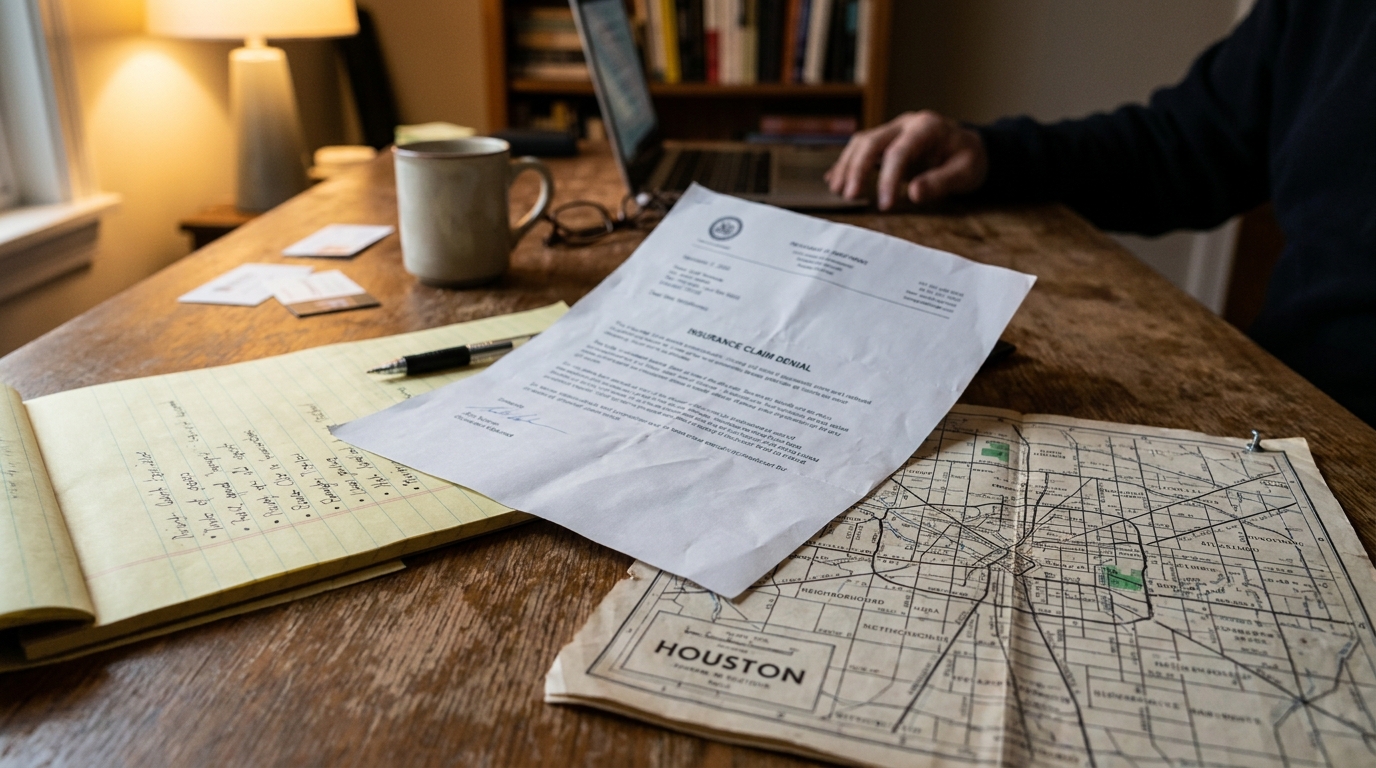
Solid documentation is the foundation of an effective TDI complaint. Insurers in Texas must communicate in writing at key stages, and those writings become your evidence. If a claim is rejected, the insurer must provide the reason in writing. Keep that denial letter, its language often reveals the violation.
Organize your records around the timeline of your claim. A clear chronology helps TDI reviewers see where the insurer fell short. Assemble:
- The original policy, including any endorsements and declarations page
- Every written communication with dates
- Photographs and independent estimates documenting the damage
- The insurer’s denial letter and any adjuster or engineer reports
- A running log of phone calls noting date, time, and representative’s name
Independent evidence is especially valuable for Houston home claim denials tied to hail, wind, or hurricane losses. Insurer-retained engineers sometimes attribute damage to wear rather than a covered weather event. A photo record and independent estimate can rebut that conclusion and show measurable damages.
💡 Pro Tip: Save metadata-preserving copies of damage photos. Original timestamps can establish that loss occurred during a specific Houston storm event.
Legal Violations That Strengthen Your TDI Complaint
Citing the specific prohibited practice separates a compelling complaint from a generic one. Texas broadly prohibits unfair insurance conduct. A person may not engage in this state in a trade practice that is defined or determined to be an unfair method of competition or an unfair or deceptive act or practice in the business of insurance. That foundational rule appears in Tex. Ins. Code § 541.003.
Several denial scenarios map directly onto enumerated unfair settlement practices. It is an unfair method of competition or deceptive act to engage in unfair settlement practices, including failing to promptly provide a reasonable explanation of the basis in the policy for denial of a claim, and refusing to pay a claim without conducting a reasonable investigation. Review the full chapter on unfair settlement practices under Tex. Ins. Code §§ 541.060(a) and 541.003.
Watch for unlawful "final" or "binding" language in your denial. Under Tex. Ins. Code § 1701.062(b), a discretionary clause includes a provision that specifies that a policyholder may not contest or appeal a denial of a claim, or that the insurer’s interpretation or decision is binding. If your denial suggests the decision is final or cannot be challenged, cite that language as a potential violation.
Documenting actual harm signals that litigation is a realistic next step. A person who sustains actual damages may bring an action against another person for those damages caused by engaging in an act or practice defined to be an unfair method of competition or deceptive act in the business of insurance. Quantifying your out-of-pocket losses makes the complaint concrete.
💡 Pro Tip: Quote the insurer’s own words in your complaint. Pasting exact denial language next to the statute it appears to violate makes your Texas insurance complaint strategy harder to overlook.
Use the Deadlines: Prompt-Pay Rules and TWIA Timelines
Missed statutory deadlines are some of the cleanest violations to document. Texas sets firm timelines for acknowledging and resolving claims. Insurers must acknowledge claims and begin investigation within 15 days, and notify claimants of acceptance or rejection within 15 business days of receiving all requested documentation. These requirements appear in Tex. Ins. Code §§ 542.055 and 542.056. Note that § 542.056 allows an insurer that cannot yet accept or reject the claim to take up to an additional 45 days if it timely notifies you in writing of the reasons.
Late payment carries financial consequences that belong in your complaint. If an insurer delays payment beyond statutory deadlines, it is generally liable for 18% annual interest on the claim amount plus reasonable attorney’s fees under Tex. Ins. Code § 542.060(a). However, for many weather-related property claims governed by Chapter 542A (which covers most hail, wind, and hurricane losses since September 1, 2017), Section 542.060(c) provides a different formula: the late-payment penalty is the interest rate determined under Tex. Fin. Code § 304.003 plus 5% (the Section 304.003 rate ranges roughly from 5% to 15%), yielding a penalty that can range approximately from 10% to 20%.
Houston storm claims often involve an important deadline adjustment. In the event of a weather-related catastrophe or major natural disaster, as defined by the commissioner, claim-handling deadlines are extended for an additional 15 days. You can read the prompt payment deadlines in Tex. Ins. Code § 542.059(b).
| Deadline | Statute | Trigger |
|---|---|---|
| Acknowledge claim, begin investigation | § 542.055 | Within 15 days of notice |
| Accept or reject claim | § 542.056 | 15 business days after documents received |
| Catastrophe extension | § 542.059(b) | Adds 15 days for weather events |
| TWIA coverage decision | § 2210.573(d) | Within 60 days of claim or information |
Homeowners insured through the Texas Windstorm Insurance Association face a distinct timeline. For TWIA policies, the insurer must notify the claimant in writing, within 60 days of receiving the claim or requested information, whether coverage is accepted in full, in part, or denied. A missed 60-day deadline or denial lacking a detailed summary is a concrete procedural violation under Tex. Ins. Code § 2210.573(d).
From a Single Complaint to a Broader Investigation
A well-built complaint can point toward systemic conduct, not just an isolated dispute. If a member of the insurance buying public has been damaged by an unlawful method, act, or practice defined in Subchapter B as an unlawful deceptive trade practice, the department may request the attorney general to bring a class action, or the individual damaged may bring an action on the individual’s own behalf and on behalf of others similarly situated to recover damages and obtain relief as provided by that subchapter. Referencing this possibility under Tex. Ins. Code § 541.251(a) can underscore the seriousness of the conduct.
Good faith obligations also frame the insurer’s duties. Every insurance policy contains an implied covenant of good faith and fair dealing, and when an insurer violates this covenant, it may be liable for damages beyond the original value of the claim. Whether enhanced damages apply is fact-dependent. For guidance, you can learn about filing TDI complaint effectively.
💡 Pro Tip: Note in your complaint if neighbors received similar denials after the same storm. A documented pattern may support TDI’s market analysis.
Frequently Asked Questions
1. Does filing a TDI complaint replace a lawsuit?
No. The TDI complaint process is an administrative review separate from a civil lawsuit. Filing a complaint can prompt regulatory attention, but it does not resolve your contract or bad-faith claims.
2. What makes a TDI complaint stronger than a basic grievance?
Specific facts paired with specific statutes. Citing provisions like Tex. Ins. Code §§ 541.060, 542.056, and 542.060, along with documented damages and the insurer’s written language, demonstrates concrete, actionable harm.
3. Can I cite "final" or "binding" language in my denial letter?
Yes, and you should. Under Tex. Ins. Code § 1701.062(b), discretionary clauses that bar a claimant from contesting a denial or make the insurer’s decision binding are generally prohibited in Texas.
4. How do Houston storm events affect my deadlines?
Weather catastrophes can extend the insurer’s claim-handling deadlines by 15 days under Tex. Ins. Code § 542.059(b). TWIA policyholders also have a separate 60-day decision deadline under § 2210.573(d).
5. What if my insurer never investigated before denying?
That may be a violation. Tex. Ins. Code § 541.060(a) treats refusing to pay a claim without a reasonable investigation as a prohibited practice, though whether it applies depends on your claim’s facts.
Putting Your Strongest Complaint Forward
Strengthening a TDI complaint comes down to documentation, precise statutory citations, and proof of measurable harm. By organizing your records, quoting the insurer’s own denial language, and tying each problem to the right Texas Insurance Code provision, a Houston homeowner can turn a routine grievance into a complaint that supports regulatory review and a potential civil claim. If you are dealing with a Houston denied insurance claim, understanding these tools puts you in a stronger position.
You do not have to navigate the process alone. The team at Fitts Law Firm, PLLC helps Texas policyholders pursue denied, delayed, and underpaid property claims. Call 713-871-1670 or send us a message through our online consultation request to take the next step toward protecting your rights.
